You can make a very high-quality “Caffenol” black-and-white film developer using instant coffee and a few other common household ingredients. There are many well-known recipes;1 my favorite is Caffenol CL. I have been using Caffenol CL almost exclusively for years with a wide variety of film.
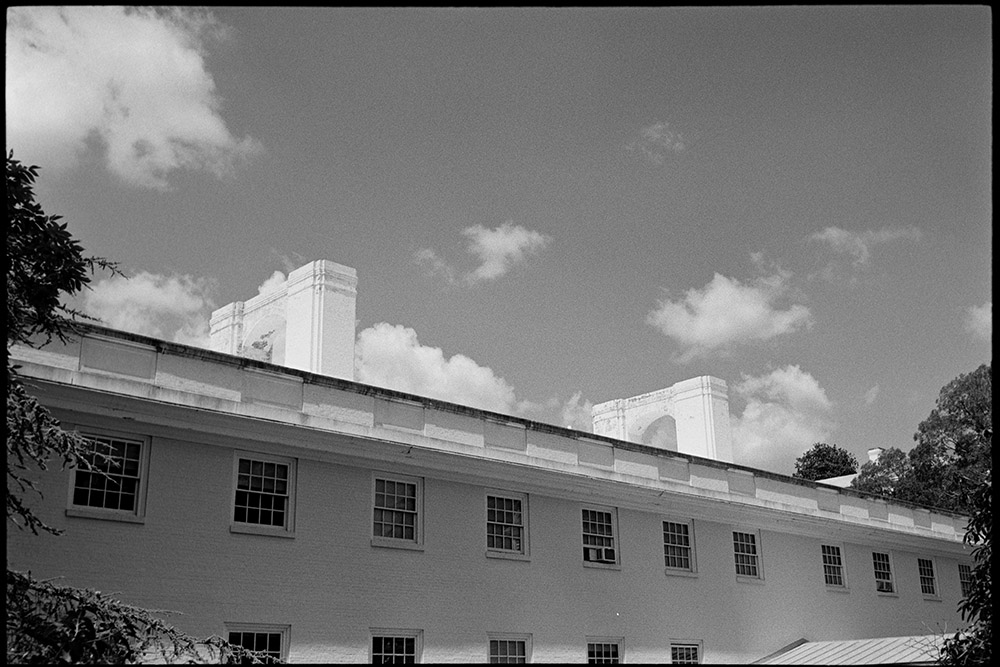 Olympus Trip 35, green filter, Ilford FP4+ at box speed, Caffenol CL at 24°C 70:00 semi-stand development. Roll 1276.
The above image was taken in blazing midday summer sun. The scene is extremely high-contrast: the chimneys are bright glaring white and the rooms are dark and unlit. Nonetheless, there is generous detail in both the highlights and shadows, and the image looks natural and unprocessed. The following image was also taken in the harsh glare of direct summer sunlight.
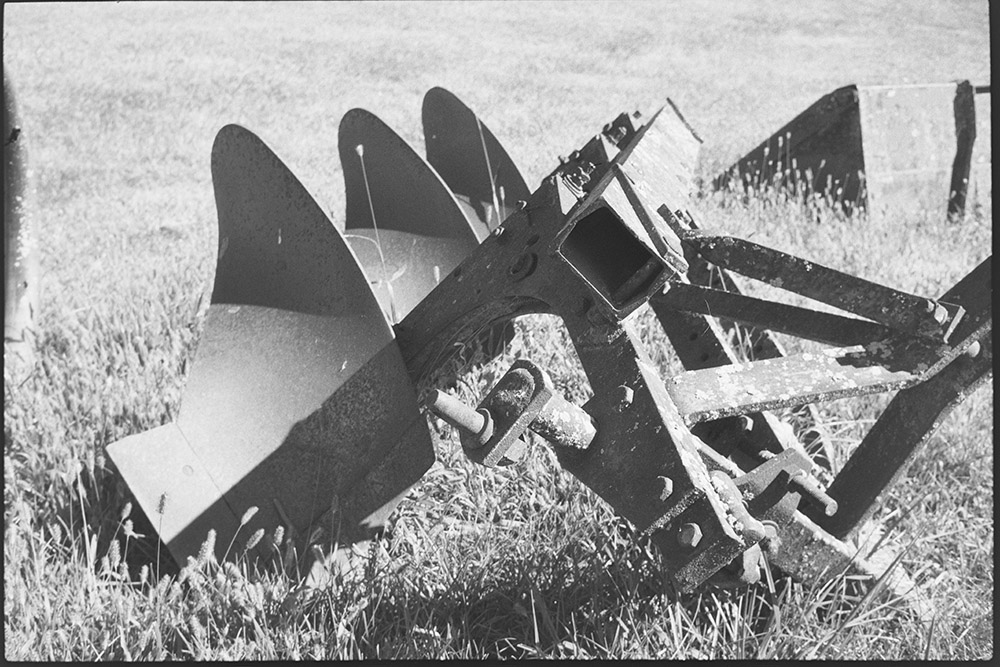 Olympus Trip 35, orange filter, Ilford FP4+ metered at box speed. Caffenol CL, 22°C, 70:00 stand development. Roll 1297.
Caffenol CL (a.ka.a Caffenol-C-L, C-C-L, etc) is a weak developer originally created2 by someone named Reinhold that creates high-quality, evenly-developed, fog-free negatives. It works very well for most traditional and tabular emulsions (e.g. great for Tri-X, T-Max, Acros, FP4+, HP5+, Delta, and Foma films among others). It also works well with high-speed films, at box speed or for pushing/pulling 2+ stops; unlike most Caffenol recipes it doesn’t fog high-speed films, or when pushing slower films. It is a compensating developer, so it produces extended tonal range with excellent shadow and highlight detail. Even in extremely high-contrast scenes, it delivers impressive dynamic compression and natural tonality. It exhibits moderate edge effects, thus generating a very slight, tasteful perception of increased “sharpness.”
Caffenol CL is suitable for extended development times due to its weakness. It can be used with all agitation schemes: Ilford agitation, stand development, or semi-stand.3 It is a single-shot developer (don’t reuse it) and best mixed fresh immediately before use.4
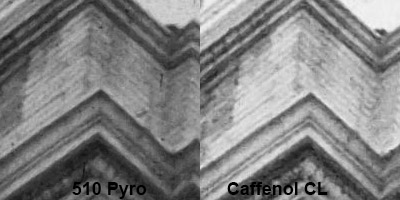
Caffenol CL produces very fine grain akin to 510 Pyro. The following image is from a single roll of identical images. I snipped the roll into pieces and processed in a variety of developers. Here I compare the grain of Fomapan 200 developed with 510 Pyro and Caffenol CL. 510 Pyro is well-known as a fine-grained developer. Do you see a materially different amount of grain with Caffenol CL? I don’t. Please ignore the minor specks visible in the emulsion; they are unrelated to the developers—Fomapan 200 is well-known for imperfections.
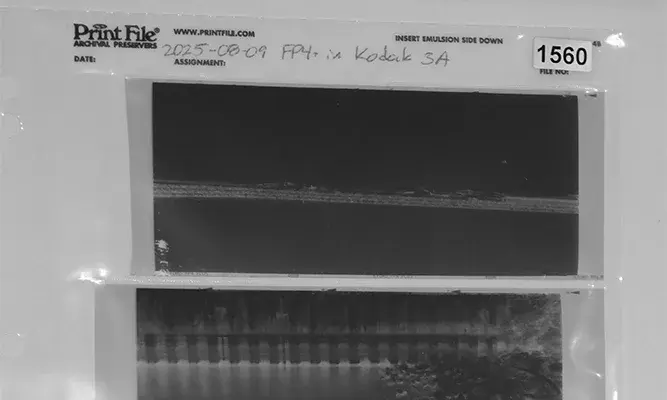
It is unfortunate that many articles on Caffenol show only scanned and processed images, not the negatives. When they show negatives, I am usually taken aback at how low quality they are, and I’m not alone. I know some photographers are dissuaded from trying Caffenol when they see murky, mostly opaque negatives that frankly just look like they’ve been soaked in coffee. One could be forgiven for thinking “this is a joke—those negatives are garbage with barely discernible images and could only be rescued digitally.” Fortunately, this is not true of Caffenol CL. You will get clear, high quality negatives with great contrast and little to no fog, easily printable in the darkroom. Look, here is an unprocessed photo of a random storage sleeve taken off the top of a pile I had nearby while writing this article.
Most of the references I cite in this article are to https://caffenol.blogspot.com because that is the original venue where Caffenol CL was published, as far as I can determine. However, there are many other mentions online as well, some of them in articles, some in comments on articles, comments on Flickr images, etc.5678910
I have also published a general overview of Caffenol film developers. I encourage you to read through that if you want to try Caffenol CL.
Recipe
Dissolve in the order given, mixing each ingredient till fully dissolved: a starting quantity of distilled water, 16 g/L anhydrous sodium carbonate (NaCO3), 10 g/L ascorbic acid (pure Vitamin C powder), 1.5 g/L potassium bromide (KBr), 40 g/L caffeinated instant coffee. Add distilled water to reach 1 L.
Unlike some recipes, Caffenol CL requires precise measurements; it is not suitable for measuring by volume. The exact amount of KBr and the pH (amount of soda) are critical to good performance; the amount of instant coffee and Vitamin C are less important. I weigh all my ingredients with a 0.01g scale and try to get the KBr, soda, and Vitamin C exactly right.
Caffenol CL usually uses up to 1.5 g/L potassium bromide (KBr) as a restrainer to to prevent base fog and unevenly developed negatives, with low- or no-agitation development and/or high-speed film.11 More restrainer reduces both fog and development; more than 2g/L KBr can produce completely blank negatives. You can use less KBr, or even omit it with low-speed film or microfilm. Reinhold initially published the recipe with 1.5 g/L of KBr, but if you read his blog posts for the subsequent couple of years, he seems to have reduced that to 1 g/L after a time. In the recipe below I list 1.5 g/L, an amount I have used successfully for years myself. I once multiplied amounts incorrectly and used 3 g/L, and my negatives were totally blank.
Too little washing soda (sodium carbonate) will result in too-low pH, which will significantly weaken the developer. Note carefully that the amount is anhydrous. Most soda isn’t anhydrous, and you need to compute an equivalent amount based on your specific soda’s hydration. Caffenol CL’s pH should be about 9.0.12
Here is the recipe again, adjusted for common quantities I use often.
| 250mL | 400mL | 500mL | 400+225mL | 1L | |
|---|---|---|---|---|---|
| Soda (Anhydrous) | 4g | 6.4g | 8g | 10g | 16g |
| Vitamin C | 2.5g | 4g | 5g | 6.25g | 10g |
| KBr | 0.375g | 0.6g | 0.75g | 0.9375g | 1.5g |
| Coffee | 10g | 16g | 20g | 25g | 40g |
| Water to final volume |
I usually start with a 10% solution of anhydrous-equivalent soda (sodium carbonate), whose water content I have previously determined by cooking off the water and measuring the reduction in weight. The soda is the slowest ingredient to dissolve, so having a bottle of 10% solution ready to use makes mixing the developer fast and easy (e.g. for 250mL I just pour 40g of soda solution into the mixing vessel, and then add the powders). I usually keep small sample bottles pre-measured with the right amounts of Vitamin C and KBr ready to dump into the soda solution, and 35mm plastic film canisters pre-filled with 10g of instant coffee, so the soda solution is the only thing I need to measure.
Development Timing and Agitation
A good starting point is 30-40 minutes at 20°C with semi-stand agitation, increasing to 60-75 minutes for up to a two-stop push and more of a compensating effect. I usually develop semi-stand for 60-70 minutes at 20°C with 4-5 slow initial inversions (about 10 seconds), then three gentle inversions at 1, 10, and 30 minutes. This pushes the film faster than box speed, but I like the tonality I get. More on this below.
In general, developing with low or no agitation increases the risk of uneven development and bromide drag. At first I saw perfectly even development with Caffenol CL, even with no agitation, but I later noticed very slight streaks in some highly revealing scenes. Since then I have almost always used semi-stand development, and I have seen no further problems on negatives up to 4x5 size. I have not seen a difference with or without a pre-soak, but some film makers suggest it and others warn against it, saying it may create uneven development.
Many variations in timing, temperature, and agitation are reported online. It is a bit tricky to compare these against each other, because one must pay careful attention to all the variables, especially temperature and agitation. A good general guideline is to vary the timing by 10% for each °C different from 20°C, or by 10:00 for each stop of pushing/pulling desired.13 Here is a synopsis of some of the various parameters people have reported online. Pay careful attention to temperature, and stand vs. semi-stand agitation; those changes make a huge difference to development speed and tonality:
- Reinhold, the original creator of Caffenol CL, recommends2 a 5-minute presoak, then 40:00 semi-stand development at 24°C for box speed with continuous agitation for the first minute, then three inversions each at 2, 4, and 8 minutes. This is about equivalent to 60:00 at 20°C, because 60*0.9^4=39.4
- Reinhold recommends12 60:00 stand at 22°C for strongly compensating development “usable on the same roll from EI 50 to EI 400.” Remember that 60:00 at 22°C is equivalent to about 74:00 at the standard 20°C; as 74*0.9^2=60.
- A guest post on Reinhold’s blog by Thomas Graichen14 somewhat later recommends a simple timing strategy, independent of room temperature: 30 minutes semi-stand for box speed with agitation at 1, 5, and 15 minutes; and 70 minutes semi-stand for a +2 push, with agitation at 2, 4, 10, and 40 minutes.
- Another guest post by Kyle LeNoir15 describes pushing Ilford Delta 400 to ISO 800 with 60:00 stand development at 21°C (equivalent to about 67:00 at 20°C).
The opinions on “box speed” and “2 stops pushed” seem to be mostly based on people’s intuition and experience with films. I don’t know of any sources where the true speed was measured formally. I personally like the look Caffenol CL gives when I expose at box speed and then develop semi-stand for 60-70 minutes. This is definitely pushing the film in development, but the exact amount is debatable. I have made some experiments to estimate the resulting true speed, but nothing very scientific. For example, in one informal attempt to guess the effective speed at which negatives were developed, I judged a roll of Ilford HP5+ to be about ISO 1250 after 70:00 semi-stand development at 20°C. (There is a limited amount of formalism in how I reached this number, but it does not match ISO standard methods and I might write more about this at another time).
Film Compatibility
I have had outstanding success using unmodified Caffenol CL with every film I have tried, with two exceptions:
- Rollei Infrared 400. Attempts to develop this film as usual result in extremely fogged, murky negatives with essentially no visible image. I think it’s under-restrained. I intend to keep experimenting, but for now, I develop Rollei Infrared 400 with other developers.
- Svema Foto 100. Omit the KBr and it develops normally. With the usual 1.5g/L of KBr, it’s over-restrained and negatives will be almost completely clear.
References
Quotations from references are edited for clarity and conciseness; sometimes only lightly, sometimes to the point of paraphrasing.
https://caffenol.blogspot.com/2010/08/caffenol-c-l.html “Recipe: 16 g/L washing soda waterfree, 10 g/L Vitamin-C, 40 g/L instant coffee, 1.5 g/L potassium bromide (KBr). Use 1-2 g/L KBr. Not more than 2 g/L, it will restrain development too much. 40 minutes semi-stand development at 24 °C. Agitation first minute continuous, 3 inversions each at 2, 4 and 8 minutes, then let stand. No fog, fine grain, perfectly even development, about box speed.” ↩︎ ↩︎
Stand agitation means you agitate at the start, then let the developer stand without further agitation. Semi-stand means initial agitation and then minimal and infrequent additional agitation, usually at increasingly long intervals. ↩︎
https://caffenol.blogspot.com/2011/06/reuse-or-not.html “Up to 2 weeks of storage I could not find any major drawbacks, maybe a slight loss of contrast. Here I reused an only 2 days old one, negs were underdeveloped. I stay on the safe side in the future and will discard the developer after a single use. But there’s no need to hurry, the developer will remain usable at least some hours without degradation.” ↩︎
https://www.35mmc.com/03/06/2022/grocery-store-development-part-2-developing-with-caffenol-and-salt-bu-josh-vickers/ ↩︎
https://jordivollom.wordpress.com/2016/05/22/caffenol-stand-recipe/ ↩︎
https://www.35mmc.com/10/09/2022/5-frames-with-the-pentax-spotmatic-and-developed-as-stand-development-by-nick-ambrose/ ↩︎
https://www.reddit.com/r/AnalogCommunity/comments/1623k2z/ ↩︎
https://www.35mmc.com/25/07/2021/caffenol-for-breakfast-my-first-experiments-with-homemade-developer-by-steven-bleistein/ ↩︎
https://on-your-kitchen-worktop.blogspot.com/2011/07/caffenol-c-l-and-tmx-135.html ↩︎
https://caffenol.blogspot.com/2010/08/perfect-development-with-caffenol-c-l.html “If you are satisfied with regular Caffenol, be happy. If you experience uneven development, agitate more and adjust time. If still not satisfied use Caffenol CL. The benefits are perfectly even development, reduced grain, and almost fog free negatives.” ↩︎
https://caffenol.blogspot.com/2010/08/caffenol-c-l-stand-development.html “BTW, C-C-L has a pH of about 9.0” ↩︎ ↩︎
A fixed 10:00 per stop of push/pull is highly debatable. I mentioned it as a general starting point because nothing about the timings and effective film speed recommended for Caffenol CL is very formal anyway. However, if you start to try to reconcile people’s reported timings for what they regard as box speed or pushing a stop or two, you’ll see that 10:00 doesn’t really match up. A better heuristic (for all development, not just Caffenol CL) is √2 increase or decrease in development time for one stop push or pull. This actually reconciles better with commonly reported timings, e.g. if box speed is 30 minutes, then pushing two stops would be 30*√2^2=60 which is about right—most people seem to feel that 60-70 minutes is a two-stop push. ↩︎
https://caffenol.blogspot.com/2011/08/its-so-easy.html “I developed with highly diluted Rodinal for some time, pushing 2 stops, but got uneven development, especially in medium format. I tried Caffenol CL for 70:00 with a 5-minute prewash, agitating 30 seconds and then 3 times at 2, 4, 10, and 40 minutes. The results were amazing. For developing at box speed I reduce development time to 30:00 with 5-minute prewash, 30 seconds initial agitation, and then 3 times at 1, 5, and 15 minutes. These strategies always work for me at temperatures from 20-25°C, and films varying from Acros (at EI 100+400), Agfa APX 100 (100+400), Kodak Tri-X (400+1600), Kodak TMX (100+400), Kodak TMY (400+1600), Ilford FP4+ (100+400), and some others. You may see examples on my Flickr Stream.” ↩︎
https://caffenol.blogspot.com/2011/06/ilford-delta-400-800-caffenol-c-l.html “So far I have done 10-12 rolls with Caffenol CL. I found the results comparable or better to stand development in Rodinal 1:100 or GSD-10. Slow agitation for the first minute, let stand for 60 minutes at 70°F. Ilford Delta 400 at EI 800 was a pleasant surprise, better than any other developer so far. I got the tones I wanted from the film finally. I feel pretty confident that it should do pretty well at EI 1600.” ↩︎